

 By rssfeeds-admin
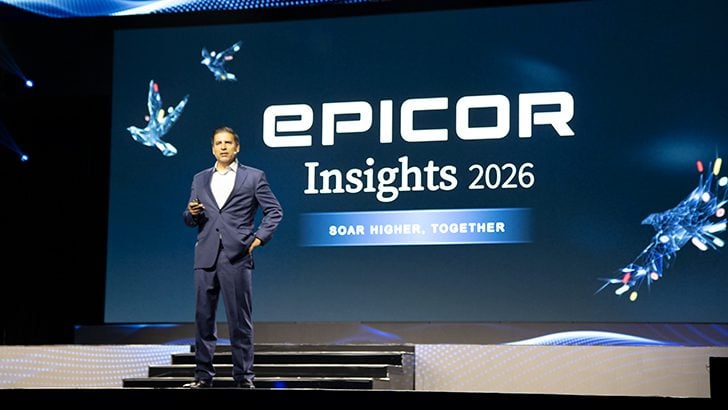 Epicor is holding its Insights conference this week in Nashville. With around 4,000 attendees, it is the largest conference it has held to date. There are around 1,000 more attendees than last year’s event, which was held in Las Vegas.
Epicor made two significant announcements during the keynote, which were a mix of vision, platform, service and product updates, and customer stories. The keynote began with Steve Murphy, CEO for the last decade, giving a practical analysis of why AI is relevant for manufacturers. He did not repeat much of the hype that other vendors are talking about.
Murphy and Epicor have a practical approach to AI. And were not shy in revealing what some may feel were contentious opinions. He does not believe that AI is costing jobs. Saying that recent job losses are more due to over hiring or other reasons rather than AI. He noted that Epicor has increased headcount, rather than shedding it, in recent years.
Murphy believes that AI augments rather than replaces people. He stated, “AI is powerful and frightening at the same time. Every one of us has to figure out what this technology does for us to make us do a better job. It automates what we used to do. And in some cases it might automate your core competency, something you were really good at.”
The key announcement was the reveal of the next iteration of Prism, introducing an Agentic AI Stack to power action across ERP Workflows. Epicor unveiled Epicor Lux, an agentic design system which will provide the underlying governance model for Prism. It also revaled its Agent Foundry.
Kerrie Jordan, CMO, Epicor, announced on stage that “[Lux] is not a product. It’s an underlying governance model for Prism, because, and this is important. We believe in empowering you to build your own agents on the Epicor platform. And to make sure that those agents look, feel, and behave like trusted Epicor products. We develop Lux to enforce a consistent user experience and security.”
The second announcement was the expansion of Ascend with Epicor, a methodology and set of AI tools that accelerate the implementation of Epicor solutions.
Creating an Agentic AI Community
In addition, and this is where Epicor has diverged from other vendors, users will be able to share new agents on the Epicor Agent Marketplace in the future. Epicor is taking an open community approach to this, where there is no monetisation involved.

This raises two potential issues: the proliferation of agents and what this means for partners. On the first, Vaibhav Vohra, President and Chief Product and Technology Officer at Epicor demonstrated on stage that before being shared, they go through automated testing and security screening, powered by AI that tests for SQL injection and other risks. In addition, before being shared to the community, the agents would be curated.
For partners, Epicor focuses on partners that have expertise in specific industry verticals. It is that knowledge and best practices they bring to engagements. Vohra answered the posed question by saying, “Where partners become incredibly important is when it comes to implementation and best practices and vertical knowledge and change management.”

Arturo Buzzalino, SVP of Product and Chief Innovation Officer noted that he answered the partner question when it was raised by them. He said, “What is relevant is that more and more code is going to be cheaper and cheaper, customisations are going to be cheaper and cheaper.”
Effectively meaning that customisation will no longer be a differentiator for partners, as customers can develop it cheaply themselves. What they need to bring is sub-industry expertise.
Evolution from System of Record to System of Outcomes
Epicor ERP are on a journey from the system of record. ERP has traditionally been described as, to the system of action they are today, towards a system of outcomes that Epicor is targeting for its solutions.
To achieve the system of outcomes, Epicor also announced Epicor Prism Agent Foundry. Which provides a guided workspace for organisations to create agents. Epicor also announced the release of more agents that will help customers deliver outcomes using AI.
As ERP evolves from a system of record into a system of outcomes, Epicor is delivering AI that moves beyond insight to action. Introduced at Epicor Insights 2026, the latest advancements include Epicor Lux, the company’s agentic design system. As well as the Epicor Prism Agent Foundry, and a new wave of Epicor Prism agents addressing high-value, decision-critical enterprise workflows.
Vohra, said “Our customers operate in complex supply chain environments where decisions must be executed quickly and with precision. Today, with Prism, we’re enabling intelligence that can execute inside the system of record. All while preserving the controls and accountability ERP was built for.”
The Foundation of Epicor’s Agentic Platform
At the heart of the Agentic platform that Epicor has built is its highly focused industry ERP solution, which brings context and business processes to the Agentic AI. Over the last two years, it has developed a data engine that connects signals across customers’ businesses. It turns the data within the platform from fragmented data points to something that is more usable, actionable and increasingly intelligent.
A solid data engine underpins the six pillars that help support the intelligent community that Epicor has built. These include:
- Industry Data Model
- Vertical Agents
- Lux Agentic Design System
- Agent Foundry
- Headless ERP
- Time to Value
Epicor also revealed the key work it has added to the data engine. It has created an ontology for the data and built a graph database. Thus, enabling AI to better understand the connections between data points and surface insights within the data.
The data set underpinning this is also a differentiation for Epicor. It has a significant proportion of data from certain sectors, such as electrical distribution and sheet metal manufacturers. In the US automotive aftermarket sector, it has access to the largest opt-in ERP dataset with around 40% of all transactions in the $54B market.
Epicor is advancing headless ERP to support AI-driven interfaces and agentic workflows. Its API-first services let AI agents, including Prism and customer-chosen LLM platforms, securely interact with and execute work inside its ERP systems.
It uses open standard MCP and maintains enterprise-grade governance, security, and control with Lux. It enables organisations to bring your own LLM. Both to access from Agents created within Agent Foundry but also to serve as a UI for Epicor users.
Epicor Lux
Lux is a control framework for Agentic Innovation. It provides the guardrails as well as guiding the look and feel of new agents. It helps users understand context, confidence, and possible consequences. While keeping the human in the loop ensures they validate AI recommendations before taking action.
Vohra commented, “Lux is Epicor’s design system. It’s the foundation for every product we ship and the vocabulary AI agents use to generate interfaces on our platform. Figma is the source of truth. Zeroheight is the front door.
“We think about Lux as having three audiences: designers working in Figma, developers working in code, and AI agents generating UI at runtime. The system has to work for all three.
“This role sits on the Design Infrastructure team. You’ll own components, tokens, patterns, and documentation that thousands of designers, developers, and agents depend on every day. At the core of this approach is Epicor Lux, Epicor’s agentic design system.
“More than a traditional UI framework, Lux is designed to help humans and AI agents communicate with ERP systems dynamically. While enforcing consistent user experience and security standards across all agents built with Epicor Prism.”
Prism Agent Foundry
Building on Lux, Prism Agent Foundry provides a guided, self-service workspace that enables customers and partners to build custom vertical-specific agents directly within the Epicor platform.
Prism Agent Foundry enables customers to use their data to create agents tailored to their specific business goals, while supporting an increasingly open agentic ecosystem. Customers will be able to orchestrate workflows and visibility tooling across ERP. While their agents operate safely within Epicor’s enterprise governance guardrails.
New agents enhance Epicor
Epicor has added more Agents to its existing portfolio. These include the first agent it rolled out, the Prism Knowledge Agent. This agent now processes over 70,000 requests monthly from within the Kinetic, Prophet 21, and Propello applications. It provides in‑context learning for users to complete tasks with greater efficiency and confidence.
Other agents are grouped into four main categories: Answers, Prism Tasks, Prism for Ascend, Developer and the Grow Data Platform.
The new and soon to be available agents on stage at Insights include:
- MRP Log Agent – Analyzes MRP output logs so users can better understand why MRP recommendations were made.
- Freight Spend Agent – Combines ERP and shipping data to identify carrier discrepancies, reconcile variances, and prevent ongoing freight leakage.
- Reasoning Agent – Helps users move from answers to action by synthesizing Epicor ERP data, documents and context.
- Quick Ship Tracking Agent – Provides fast access to shipment tracking information using PO, SO, or customer names, helping teams quickly understand shipment status.
- Quick Ship Freight Insight Agent – Delivers shipment volume and performance insights at the carrier and facility level, enabling logistics decisions based on pattern analysis.
- Prophet 21 Prism Business Rules Agent – Allows P21 users to create and modify business rules from natural language prompts while preserving platform governance.
- EDI Agent – Enables Kinetic users to ask plain-language questions about EDI document status, investigate errors, and review transaction status.
- CPQ Snap Assistant – Increases efficiency for CPQ administrators during configurator development and maintenance.
- Smart Data Capture Agent – Extracts and validates complex documents across AP and compliance workflows.
In addition, Epicor is developing at least a further 30 agents that will assist organisations in several business processes, including: financial planning and optimisation, compliance, invoicing, logistics, and sustainability use cases. The Epicor approach is to ensure that the agents it creates are useful to organisations that use its applications. Customers seem to agree.
Daniel Epler, Chief Financial Officer, Tuffaloy Products, Inc., commented, “Prism delivers ~85% faster shipment tracking by collapsing multi‑system lookups into a single‑click, single‑view experience-enabling near‑instant customer responses and higher customer confidence.”
Enterprise Times: What does this mean
Epicor laid out its cards in Nashville as it seeks to educate and lead its community of distributors and manufacturers into the age of AI. What was clear, talking to customers at the event, is that many are seeking to move to the cloud over the next few months. The announcement around Ascend with Epicor will have pleased them.
The well-thought-out AI strategy that Epicor laid out, which in some ways is ahead of many other ERP companies, will also satisfy them. It is not, however, the only ERP company to take the approach of industry focus or have a solution that enables the creation of Agents. SAP announced similar platform updates in Madrid this week during its European Sapphire conference.
What was clear is that Epicor believes its advantage lies in the data within its ERP solutions. AI can leverage this validated, real data created by customers to benefit clients, rather than relying on data generated by AI itself. While with the help of AI it is moving to become a system of outcomes, it is the system of record and the data it holds that could see it further strengthen its hold on certain markets.
Vohra concluded, “AI only succeeds in production when it’s grounded in reality. That requires deep industry knowledge, a trusted ERP data model, and enterprise‑grade security. All of which are capabilities that uniquely position Epicor to bring AI into real supply‑chain execution at scale.”
The post Epicor takes a community approach to Agentic AI appeared first on Enterprise Times.
Discover more from RSS Feeds Cloud
Subscribe to get the latest posts sent to your email.