

 By rssfeeds-admin
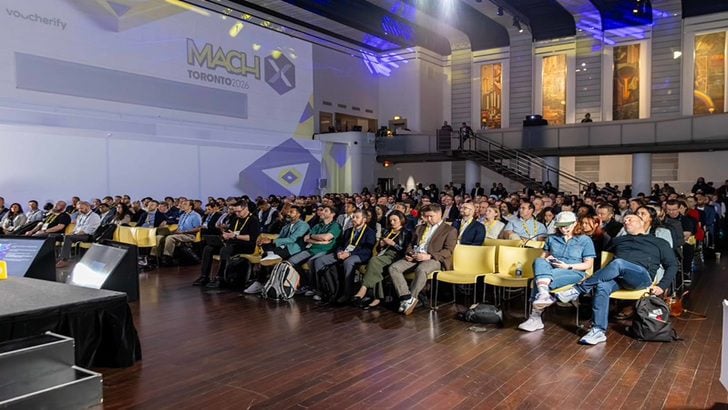 The MACH Alliance hosted a panel discussion on Towards a Fully Enabled Enterprise at its MACH X event in Toronto. The event, The Agentic Advantage, aimed to help enterprise leaders shift from AI trials to developing “AI-ready” systems with composable technology.
The panel explored how their organisations are moving beyond pilots towards embedding AI into the fabric of the business. This transformation is taking place across strategy, governance, culture and day to day work. Environments where AI is not a side project, but a core operating capability. The panel was facilitated by Dana Lawson CTO at Netlify. It included Caitlin Curran-Blaney VP, Digital at RBC Insurance, Scott Adel, AVP AI Activation at Canadian Tire Corporation and Chris Di Lullo Senior Director Product Management and Design at Grubhub.
From “Digital Transformation” to a fully enabled AI enterprise

AI is forcing organisations to revisit foundations—architecture, workflows, and culture—rather than just bolt on new tools. A “fully enabled enterprise” means systematically embedding AI, not just “letting the robots in.” Lawson emphasises that this isn’t a brand new journey, but a new phase of long running transformation. Later, she challenged a common but simplistic narrative to just let the robots come in and take over current work roles. “We all have been going through digital transformations for the past 20 years. So, what does it really look like in people in the enterprise?” In other words, the end state isn’t “AI everywhere.” It is an organisation where people, process and technology are aligned around responsible, scalable AI use.”
And she outlined the cultural shift AI is creating in how employees operate. “It’s incredible, because now it’s really all of us are becoming these product managers, in some sense. AI and low-code tools now let people design and reshape their own workflows and experiences. So, they must think in terms of user needs, outcomes, and system design—not just executing tasks,” said Lawson.
She also adds a critical caution, “Just because you can doesn’t mean you should, remember that.”
Upskilling, responsible adoption, and redefining “Using AI”

An AI-enabled enterprise depends on continuous education, responsible experimentation, and moving beyond superficial “AI usage” metrics towards real work redesign. Curran-Blaney highlighted the tension between strong governance and the need to keep people current.
“One of the things that’s been really challenging for us is strong, structured governance. As the business rolls out the technology, how does the organisation scale up and ensure employees are always absorbed and on the cutting-edge? Education is critical, ensuring the company sponsors training and employee understanding is evolving.”
She pushed back on “AI mandate” thinking. “Just hearing and seeing how many people are mandated to use AI is the wrong approach. It should be, how are you taking parts of your role and using AI to shift work. So that employees can focus on more productive aspects of their role.
“It’s about understanding job roles at a much deeper level than just, ‘I use an LLM.’ Her core point: In a fully enabled enterprise, the key metric is how work is being re-architected with AI, not how many people have touched a tool.
“Big Rocks”, productivity, and democratisation

To avoid AI devolving into disconnected experiments, firms need to put structure around their ambitions. Adel described how Canadian Tire divides its AI agenda into three distinct streams. To scale AI across their enterprise, needed a clear strategic structure that distinguishes market-changing bets from productivity plays, and that creates a safe space for bottom-up innovation.
“We’ve done a really good job with our president and executive teams around strategy, so we’re really on the top down. We have separated it out in three large components”
This model is instructive:
- Big rocks: high-impact, market-facing initiatives where AI can create real differentiation.
- Productivity projects: internal workflow automation and optimisation.
- Democratisation: enabling employees to build and experiment, within guardrails.
Crucially, Adel sees AI as a leadership competency, not just a technical one. “Everyone from an Associate VP up to the CEO is on AI certification programme. Specifically, to support understanding governance and data to help us drive this from our leadership.”
And he is blunt about the career implications of ignoring AI. “Are some jobs going to be affected? Yes, some jobs are going to be enhanced. If employees are working not using AI, then they will be effectively replaced by people who can use AI.
“I think it’s exciting. Employees who don’t have the same education can do things that were only previously allocated to a few individuals from Stanford or MIT,” he added.
Evolving governance

As AI becomes ubiquitous, enterprises must move beyond controlling access to controlling outcomes says Di Lullo. Businesses should start focusing on experience, equity, and risk, at a much higher speed than previous tech waves.
Di Lullo suggests governance has to shift from simply controlling who can access software to governing what AI systems actually do and the outcomes they create. He expects businesses to focus on consumer experience, equity, and risk. Furthermore, doing this much faster than in previous tech waves.
Much of the current AI landscape can be characterised by experimentation with many enterprises deliberately in the process of trying out AI ideas in small, low-risk ways. These developments are designing tests, measuring results, and iterating. To learn what actually works before it can be scaled it across the business.
On experimentation, Di Lullo noted that pure freedom is not enough – some structure is required. His view of a fully enabled enterprise is one where many people can build. However, within a governance model that keeps consumer experience, fairness and risk at the centre.
Pulling It Together: What “Towards a Fully Enabled Enterprise” really meant
Across their perspectives, the shared themes are:
- It’s a second transformation wave: AI forces organisations to revisit foundations (Lawson) rather than just add tools.
- Structure matters: Clear categorisation of AI work into big rocks, productivity, and democratisation (Adel).
- Governance must evolve: Shift from access control to outcome-centric governance anchored in equity and experience (Di Lullo).
- People are at the centre: Continuous upskilling, manager-led support, and moving beyond “AI usage” vanity metrics (Curran Blaney).
- Everyone’s role is changing: Employees increasingly act like product managers of their own workflows (Lawson).
- Those who don’t engage with AI risk being outpaced (Adel).
Together, these themes define what the panel means by a “fully enabled enterprise”. An organisation where AI is embedded in strategy, architecture, governance and everyday work. With people empowered—and expected—to redesign how value is created, but always within clear, responsible guardrails.
Earlier in the year, the MACH Alliance released a report on the relationship between composable infrastructure and successfully adopting AI. The MACH Alliance Enterprise Technology Report surveyed 600 enterprise technology decision-makers in seven global markets. The report examined the impact composable technology has on AI implementations now and where it’s heading to support agentic AI. The research highlighted the role composable plays in AI, as companies head toward the future of multiple AI agents.
The question enterprises faced in the report isn’t whether to adopt AI. It’s whether the infrastructure can support AI at scale, integrate AI capabilities across systems, and adapt as AI technology evolves. The discussions from this panel are a superb starting point for any organisation with ambitions to become fully enabled AI-enterprises.
The post MACH discusses the move towards a fully enabled AI-enterprise appeared first on Enterprise Times.
Discover more from RSS Feeds Cloud
Subscribe to get the latest posts sent to your email.