

 By rssfeeds-admin
As other readers commented, the device has a lot of similarity to other products in this class. I’m guessing there is a common board design that OEMs use to make variants of the product.
Here’s additional context of the ware, for completeness!
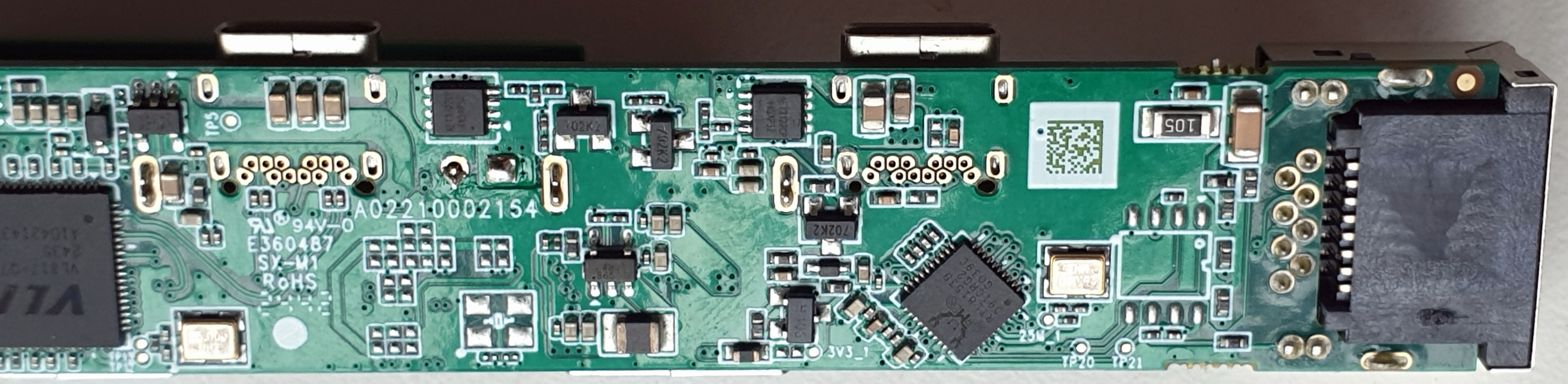

This one claimed to have “PD” capability, such that one of the USB-C ports could be used to deliver power to your system, up to 100 watts, thus freeing up a port for data use that would normally be used for power. This turned out not to be the case – the device suffered a quick and catastrophic failure of some sort which didn’t leave any visibly burned out components but left it in an “unreliable” state – it could enumerate, but would quickly reset itself and shut down. The second device I got of this type, from a different manufacturer, suffered a similar fate, except it at least continued to operate with its peripheral functions minus a USB type C port. I’ve more or less given up on trying to go that route – my guess is most laptops do not, in practice, draw more than about 40-50 watts, so perhaps manufacturers can get away with claiming 100 watts but “only in theory”. My laptop will continuously draw close to the full 100 watts from any supply that claims to deliver it, especially when I’m doing CAD tasks that exercise the GPU and CPU for hours on end, or if I’m simultaneously charging the battery and using the laptop.
Discover more from RSS Feeds Cloud
Subscribe to get the latest posts sent to your email.