The Sinking City 2 Preview: A Promising but Inconsistent Eldritch Horror Adventure
Not that long ago, it didn’t even seem like we were going to see a sequel to The Sinking City at all, since Ukrainian developer Frogwares was hit just as hard by the economic and material consequences of Russia’s invasion of the country in 2022. But in 2024, The Sinking City 2 was announced, in 2025 the Kickstarter to help fund it was completed, and earlier this month, I got to spend a couple of hours soaking in its cosmic juices. There are some differences small and large in this sequel – a different story and protagonist, a different titular sinking city, and scaling back from an open-world adventure to a more survival horror action game – but doesn’t this help the series float above its peers?
A few things are pretty similar between the first and second games right off the bat. You play a private detective wading through knee-deep flood waters in a post-Great War city in New England. You’ll travel around that city, chatting up its very colorful denizens and sniffing around dark corners in order to find leads to uncover the source of the dark magic that’s giving everyone the heebie-jeebies around here.
But this is not a direct sequel to the story of the first game. Though similarly leather jacketed and fedora’d, Calvin Rafferty is a much different guy than previous protagonist Charles Reed. He’s still haunted by ghosts, but as Charles’ were more metaphorical due to all that PTSD, Calvin’s are literal. His lover and partner in crime, Faye, has had her spirit separated from her body, and it inhabits a mask that he carries around with him. The famous Arkham City is the one sinking this time, and Calvin believes that somewhere in it is the key to returning Faye to this mortal coil. Even though I didn’t spend much time with them, this duo is a huge step up from the last game’s protagonist in terms of depth and even likability. The latter isn’t as important if the former is there, of course, but I certainly enjoy Calvin more than Charles, and I’m much more invested in his mission and the future for him and Faye.
The scope of our hands-on demo was two different sections of missions spread across different parts of the game to show off the new investigative bits and more action-centric sections, respectively. The Sinking City 2 scales back the open-worldiness of the first to lay out most focused areas that cut down on the tedious backtracking of the first game’s zones and are more dense with stuff to see and do. I’m not sure that my short trip through the water-logged streets of Arkham was enough to really compare scale to the first game directly, but the pacing of both missions felt more intentional.
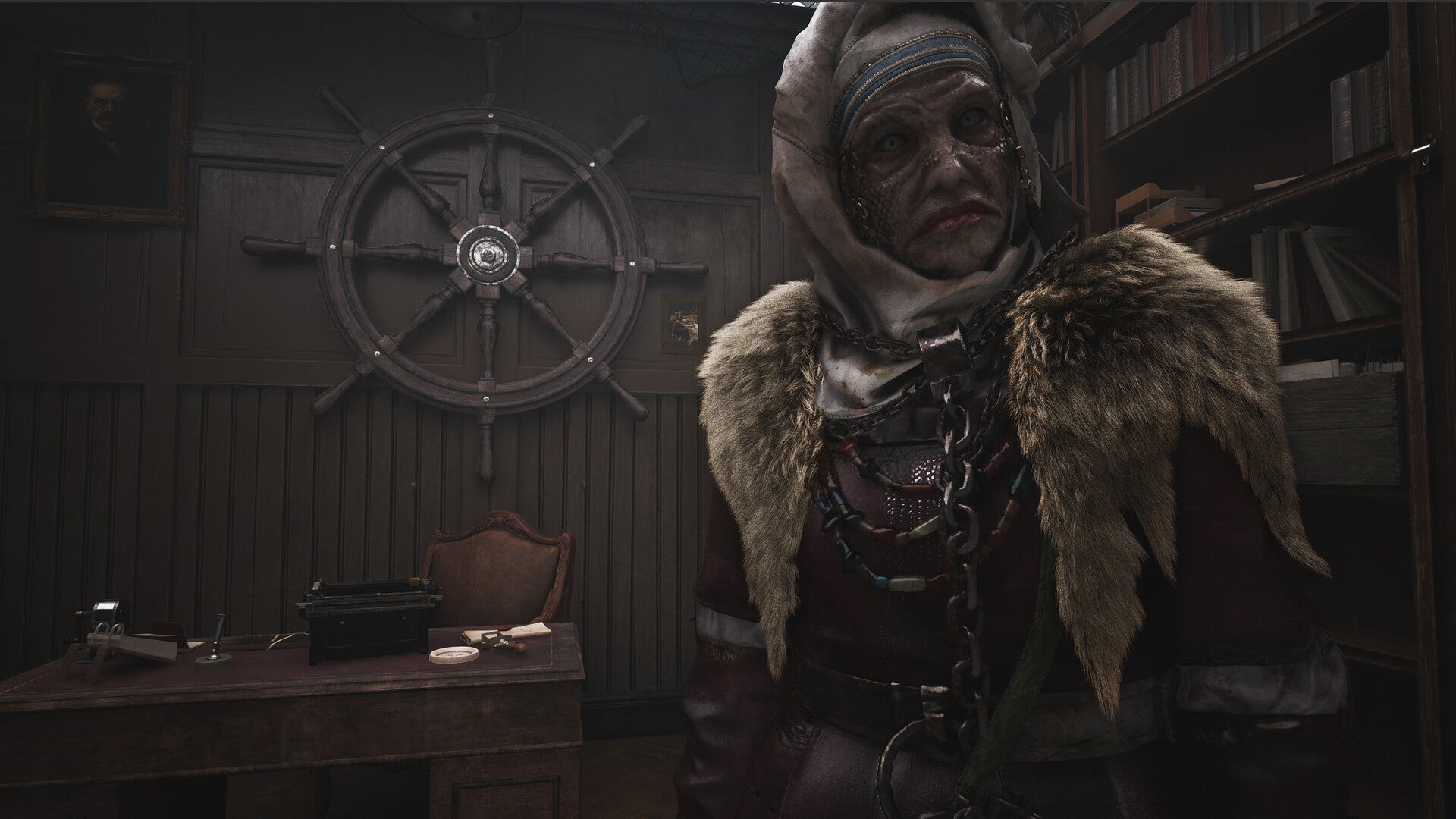
The first Sinking City had an interesting world, sort of melting several of Lovecraft’s stories into one big pot of magical fish devil soup. Fish-faced people and gorilla men shared the Oakmont streets with “regular” people in what could be mistaken as a twisted sort of harmony at first glance. In the bit of Sinking City 2 I played, there was barely anyone in Arkham alive to speak to – though the ones that were around were thoroughly strange, including a man who traded his eyes for slithering leeches that gave him the ability to “see beyond the veil.” What I did get a big helping of is how this sequel leans even more heavily into the science fiction of it all. In the second mission in an abandoned hospital, doors are locked by futuristic (by 1920’s standards) facial scan devices, for instance. This all came together to create a world that speaks the weirdness out loud instead of in whispers, and points to a final project that wants to take every opportunity it has to make a unique case for this cosmic horror presentation in a setting that is filled to the brim with contemporaries.
Some new approaches to old investigation and puzzle systems were very welcome. Specifically, the investigation part is overhauled. Instead of having to take clues to specific points in Oakmont to research what they could mean for you takes ahead, sometimes requiring hours of trial and error to get right, the original’s Mind Palace concept has been expanded, allowing you to make connections through leads and clues from anywhere. In action, the new Investigation Space acts like an evidence board to pin your clues to and gives you the option to link pieces of evidence together to group them. It’s similar to but not as elaborate as the system in fellow Cthulhu Mythos-themed game, The Cosmic Abyss, but it’s a way easier system for organizing your thoughts without completely abandoning the sleuthing that made the first game stand out among its third-person action-adventure peers. I do miss the flavor of having to go to the library to fill out details of a case that I’m missing, but I don’t think I’ll miss the labor of actually doing it.
The one real puzzle I got my brain around was a pretty standard one. I needed to organize the symbols on a pylon in the right sequence in order to activate an object, with clues about those details scattered around the area and ready to be found if I was ready to take the time to look. Without elements like Minds Eye, the sort of detective mode/precognition mechanic from the first game, present here, there was really nothing more to finding the answer than reading some notes conveniently left behind by cultists. Also not present in the demo was a good example of one of the original Sinking City’s greatest strengths: morally ambiguous choice making. I didn’t really make any decisions here outside of if to shoot a monster and where.
Combat is as inconsistent as the gifts from the elder gods. While trudging through the wet streets of Arkham, enemies come in small bursts. The twisted corpses that rise from the whatever state of undeath they were in shimmy at you at a staggered pace. They’re pretty durable save for pulsating boils on their bodies that beg to be popped with a bullet. It’ll regrow some other place on their mangled form, but waiting and shooting the next one is more efficient than just spraying and praying. They’re manageable alone, but as their numbers grow, you run desperately out of time to put a bead on these weak points and pull the trigger.
It’s when things get messy like this that the third-person shooting of it all feels its most janky. The aiming and strafing and looking and turning are all just a little too loose, even after some adjustments to the axis sensitivities. Fighting non-human terrors, usually little spider-like creatures that scurry, climb, and leap around quickly felt pretty bad everytime. When trading blows with monsters, damage done to you barely registers legibly – you definitely take the damage, but you don’t flinch and there’s no noticeable sound or screen effect register at all. Hopefully this is addressed before the final release.
Going toe-to-toe with the monsters is a mistake as their numbers grow and your resources dwindle, and running away is often the best option. It sometimes feels like it undermines these encounters completely when I jump through a church window and all of the human-handed arachnid creatures kind of shrug and wander back into the graveyard, even though I know I’ll need to go back out there to solve a puzzle later. But moments built around this idea, like a later moment in a hospital where gangly zombies are literally bursting through the walls to rip you to pieces, really make running away feel properly chaotic and necessary.
The weapons are also just fine. The shotgun barks with a satisfying boom, but the pistol and submachine gun didn’t feel as satisfying or powerful. I admit there’s some synergies with the new talents system that I didn’t dabble with much that could change this. Buffs to damage when you switch weapons or having a damage buff after killing enemies is the kind of meta mechanic that can become important when trying to make every shot count and I definitely did not prioritize figuring that out here. And of course, this little slice of the game I played was still an early prototype, with plenty of performance hitches that had noticeable effects on every button press I made. Par for the course for a preview like this, and nothing I would commit the Frogwares team to an eldritch ritual over.
The Sinking City 2 has made big changes in the hopes of capitalizing on the untapped potential left to float in the void in the first game. A better, more interesting protagonist; a revamped and easier to parse investigation system; and better-paced missions might help this eldritch sequel rise above clever curiosity for fans of tentacle-tinged horror and into must-play territory for everyone this time around, so long as it’s not held back by the underwhelming combat and puzzles that nagged the previous game and don’t seem to be fully solved here just yet. We’ll find out when The Sinking City 2 hits PC and consoles this summer.
Jarrett Green is a longtime contributor to IGN. Say hello on X @Jarrettjawn.
There has been a lot of talk about the AI bubble. Much of that has…
Red Hat and Panasonic Connect are to collaborate on redefining the capabilities of ruggedised edge…
There has been a lot of talk about the AI bubble. Much of that has…
There has been a lot of talk about the AI bubble. Much of that has…
Red Hat and Panasonic Connect are to collaborate on redefining the capabilities of ruggedised edge…
Red Hat and Panasonic Connect are to collaborate on redefining the capabilities of ruggedised edge…
This website uses cookies.