

 By rssfeeds-admin

All six episodes of Bait Season 1 are available now on Prime Video.
On the silver screen, the actor playing 007 has been Scottish, English, Irish and Australian, with a few different hair and eye colors, but the character has always been a white man serving the British Crown. Every new Bond film brings with it conversations, both for and against, about this status quo; these have been happening so long that Idris Elba has even aged out of being repeatedly fancast. And since we’re currently in a period of Bond limbo, as Daniel Craig passes the torch to whoever’s picked by the Bezos regime, it only makes sense for a British Asian star like Riz Ahmed to throw his hat in the ring.
Not so fast.
Enter Bait, the zany six-episode series in which Ahmed fictionalizes this outcome, and dispenses with all the familiar, well-worn tropes of the discourse while finding hilarious new dramatic layers. It begins with Ahmed’s character, the up-and-coming actor Shah Latif, screen-testing for the iconic role and giving us a taste of what a South Asian James Bond might look and feel like. He’s not a bad actor, but he flubs the try-out and snatches this promise away from us.

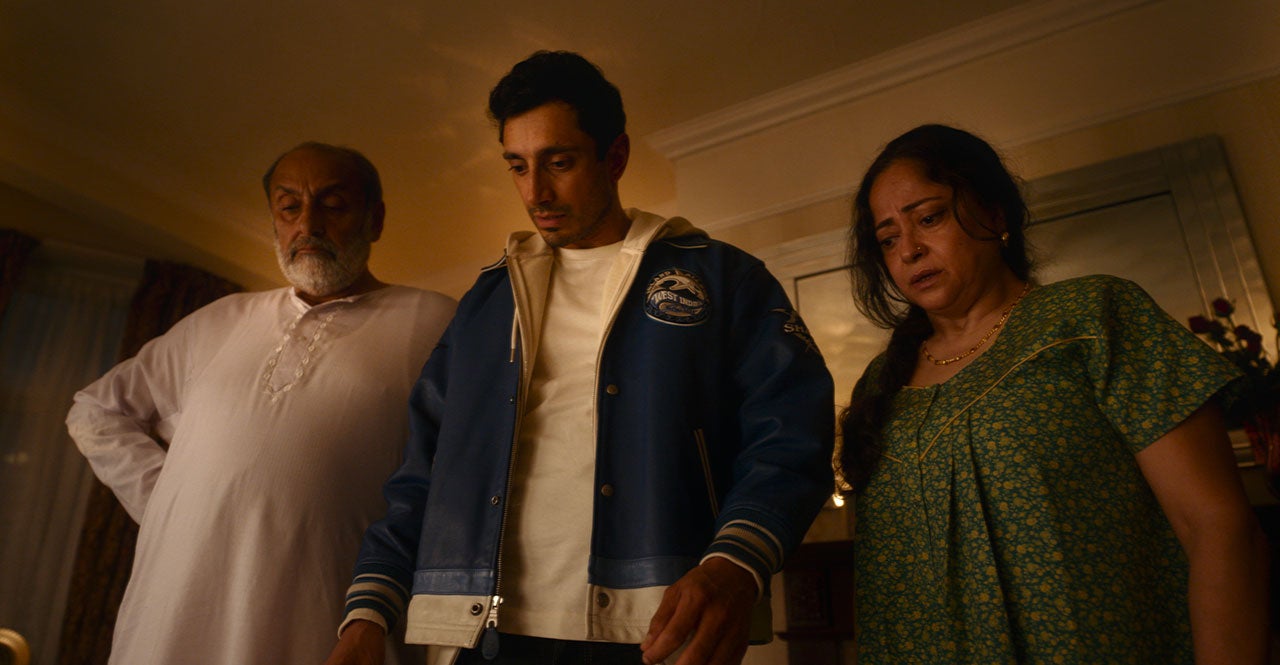
What follows is part domestic sitcom and part industry drama, in which Latif becomes torn between community commitments and the Hollywood ladder, as he slyly positions himself as a favorite in the media. However, the show isn’t as straightforward as it might initially seem, because at this point in his career, the 43-year-old Oscar nominee (who also serves as the series’ writer and EP) knows full well what pressures the spotlight brings. Thanks to the directorial talents of Bassam Tariq, who directs the first three episodes, fissures gradually form in the series’ fabric and in Latif’s psyche, yielding a saga of self-destructive ambition. By the end, it isn’t really about the idea of an Asian Bond at all, but rather how being subsumed into these cultural conversations can tempt a person, or even break them.
Tariq last directed Ahmed in the feature Mogul Mowgli, a surrealist hip hop drama steeped in similar notions of fractured postcolonial identity. Bait is practically a stylistic sequel, with scenes of familial mayhem taking on chaotic hues, as wide lenses warp spaces that ought to be safe and comfortable, like Latif’s family home, when chatter about his audition hits the airwaves. Gossiping aunties become secondary villains, as the show’s backdrop contorts to fit the idea of a traditional Hollywood hero who has to contend with Eid celebrations, an ex girlfriend (Ritu Arya) with pointed opinions about why Bond should never be South Asian, and a hustler cousin (Guz Khan) who hopes to establish London’s first Muslim rideshare app. Whether or not Latif, or Ahmed, will ever play 007, this is what authentic dramedy looks and feels like, even when it comes wrapped in complete absurdity.
The more Bait seems to establish a tonal baseline, the more it departs from it in hilarious, occasionally jaw-dropping ways. By the second episode, it starts to fly off the handle until the show eventually loops back to become a story about mistrust, self-loathing and psychosis – all within the body of a unique spy saga unto itself – answering the question: What happens to a man when an identity like Bond is projected onto him and he isn’t ready for it?
Minor spoilers to follow.
It sounds nonsensical on paper, but a major supporting character in Bait is a severed pig’s head voiced by none other than Patrick Stewart. Take all the time you need to fully digest this, because the show certainly doesn’t give you any before it yanks you into this bizarre-but-gripping subplot.
At the end of the first episode, Latif’s family home is vandalized in a racist hate crime, as a pig’s head is thrown through his window, a frightening image that lodges itself into his subconscious in unexpected ways. By the second episode, he’s having full-blown podcast conversations with the deceased boar about having already usurped the role. It is, on one hand, a fantasy about the media circus that tends to follow such announcements, but it’s also a darkly funny break from reality that, fittingly, takes the form of another mid-century British hallmark, William Golding’s The Lord of the Flies.
The allegories in Bait remain broadly similar to those in Golding’s novel — “This is how the world works” — only here Tariq and Episodes 4 through 6 director Tom George refract the story through the lens of a swiftly-moving, ever-shifting media landscape. The only respite Latif finds is a romantic rendezvous with his former flame that plays out in alluring long takes as they traipse across London’s nightlife (it’s hardly a breather), and by the time the show gets to Episode 5, it becomes a balls-to-the-wall meta commentary on the whole idea of the Hollywood spy movie.

Latif, having been convinced his family has been kidnapped as reprisal for the potential casting, finds himself paranoid and on the run, as George departs from Tariq’s loopy, wide-lensed camera work and instead employs a more relevant contemporary aesthetic: the post-9/11 voyeurism of the Bourne films, with long lenses that peer in on Latif from a distance as he charges through a train station. He’s even approached by a former ally who turns out to be working for the British government, and who hopes he’ll toe the line of government propaganda should he play the part.
Is any of this “real,” in the strictest sense? Who’s to say. The warping and filtering of real discourse through formalistic comedy-drama blurs the edges of reality in delightful ways, until all that’s left is the underlying suspicion that people want Latif to fail — or only want him to succeed for their own benefit. That he constantly has to put on false identities to navigate shifting allegiances makes Latif more Bond-like than he realizes, making Bait not only a show about the hypotheticals of South Asian Muslim Bond, but a pitch-perfect satire of why such a thing may not fit the escapism of the 60-plus-year-old IP in the first place, given how close to reality the concept already skirts for someone like Latif.
A frequent retort in the “against” column, for a non-white Bond, is that people of colour ought to have their own figures in mainstream media, but whether or not this argument is introduced in good faith, Bait responds to it by having its cake and eating it too. It creates a unique, culturally-specific story that only these particular creatives could tell, but it also circles the fantasy of an Asian Bond in so close a manner that audiences who really want it can practically reach out and touch it. What’s more, it kicks off any ensuing debates about representation for them.
Which is by no means to suggest that Bait is a close-ended show with no room to foster conversation. If anything, it’s the opposite: It opens up new avenues by building off the same handful of dimensions and bullet points that have already been discussed ad nauseam in the media and online. Its main focus isn’t just how the story of Bond would change given the presence of an actor like Latif, but how Bond would change Latif’s own story, for better or worse, and it’s a rip-roaring hoot along the way.
Discover more from RSS Feeds Cloud
Subscribe to get the latest posts sent to your email.